


Creativity & Consciousness for Change: The Yoga of Imagination and Interbeing
Updated: Sep 1, 2025
What if every creative act was a thread in the fabric of collective transformation?
By Cynthia Sciberras, Founding editor YOKE Magazine
It’s only now, 10 years on, that I feel able to articulate what YOKE truly represents—beyond a name, beyond a magazine. Over the past decade, each person’s contribution, each voice, each spark of wisdom, has allowed the spirit of this publication to evolve. And in witnessing this unfolding, I’ve come to trust something fundamental: when you lean into something bigger than yourself, the creative act always finds its way to be born.
Because by the sheer nature of being human, we are creative. Creativity is not a choice—it is a birthright. It is woven into our bodies, our breath, and our consciousness. In a time where everything feels accelerated and broken—information, productivity, even crises—we need imagination. We need creativity that is awake, alive, and grounded and radiating consciousness. Because creativity isn’t just a personal pursuit; it’s a practice of re-remembering who we are, and what we’re here to co-create.
Creativity has always been a force for change. But what does that really mean? I’ve been exploring this since YOKE’s inception, through these three lenses: the self, the collective, and our planet.
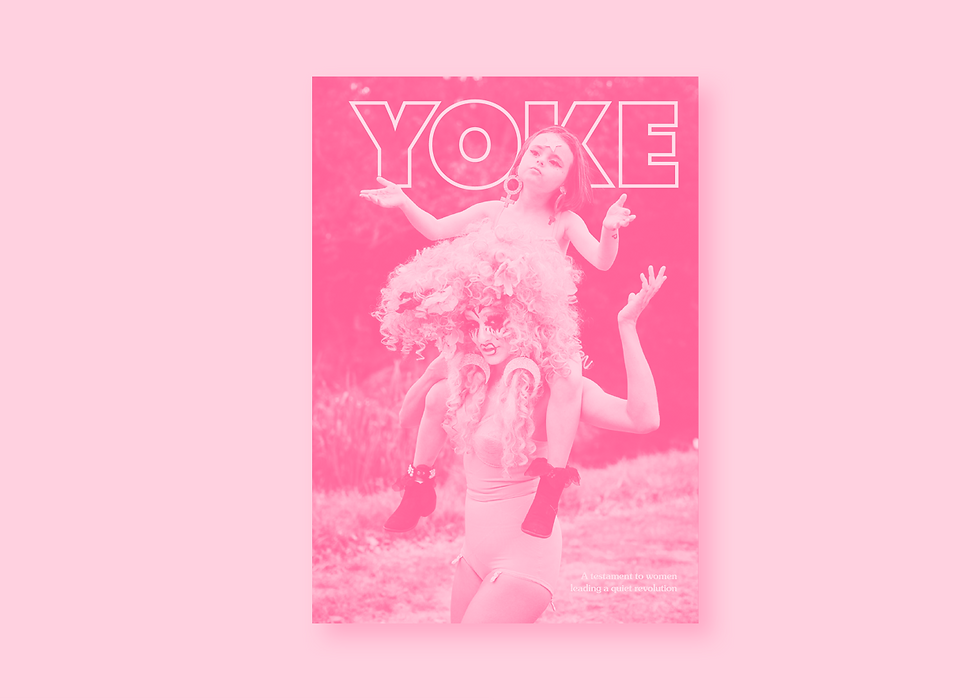
Why YOKE?
When I founded YOKE in 2014, the name was intentional. It’s not just a word—it’s a philosophy.
YOKE comes from the Sanskrit root yuj, the same root as yoga. It means to yoke, to unite, to join. It’s union at the deepest level: the finite with the infinite, the individual with the universal, the human with the more-than-human world.
“Yujyate anena iti yogaḥ” – That which joins is yoga.
Creativity, at its highest expression, does this. It unites what feels fragmented. It weaves threads between inner and outer, self and other, matter and spirit. Creativity is a sacred act of yoking—the act of joining the seen with the unseen, the possible with the impossible, the now with the eternal.
Beauty, Belonging, and Love: The Three Pillars
If there are three qualities that keep resurfacing in our conversations and storytelling here at YOKE, they are beauty, belonging, and love.
Beauty softens us, awakens awe, and calls us back to presence.
Belonging reminds us that we are not separate. It is the glue that holds the fabric of life.
Love—the deepest force of all—binds everything together.
My Ashtanga yoga teacher, Eileen Hall, reminds us: “True yoga starts with our relationships.”
Love isn’t just a concept—it’s a lived practice. It begins in how we show up for each other, for our communities, for our planet. In the Yoga Sutras, this is called Īśvara praṇidhāna—surrender to the divine, or love in action.
Love enters creativity not as ornamentation but as origin. When beauty, belonging, and love converge, life ceases to feel fragmented. Life, becomes a living, breathing work of art in of itself.
Yoga Sutra: Beauty as a Pathway to the Infinite
Patañjali’s Yoga Sutras are a timeless map for the expansion of consciousness—a journey toward viveka khyāti, the discriminative wisdom that allows us to see clearly what is real and eternal. Among these aphorisms, Sutra I.39 offers a profound key:
“yathābhimata dhyānād vā” — Or by meditation on whatever is elevating.
In essence, Patañjali reminds us that the path to stillness and union is not rigid or prescriptive; it is alive, intimate, and deeply personal. Anything that uplifts the mind and opens the heart toward the sacred can become yoga. It need not be confined to the mat or the ritual—it can be found in the luminous moment of creativity.
For many, that doorway is beauty. In painting, writing, movement, music, or any creative act infused with awareness, we move beyond ego into flow, touching the infinite.
Beauty, then, is not a luxury or superficial; it is a spiritual practice. A way of communion. It elevates consciousness because it reminds of wholeness, and interconnection. When we create or behold beauty, we experience a brief but profound alignment with something beyond ourselves. In that alignment, the finite touches the infinite.
This is why the pages of YOKE have always held space for artists, poets, and makers—not as a celebration of aesthetic alone, but as an acknowledgment that creativity itself is yoga in action. Art becomes the bridge—a mirror reflecting our psyche and a portal opening us to grace.
The Individual: The Artist of Your Own Life
Creativity starts in the quiet, messy, raw spaces of the self. Ask:
What does creativity mean to me beyond making something beautiful—how does it shape who I am?
What old patterns do I need to unlearn to allow new possibilities to emerge?
In what ways are my daily choices acts of creation—or destruction?
To live creatively is to take responsibility for the story you’re telling through your choices, your voice, your presence. Shift from consumer to creator—you stop waiting for change and start embodying it.
The Community: Collective Imagination as Culture
Creativity belongs to the commons. Communities rise—or collapse—on the strength of their shared stories. Ask:
How can creativity reshape systems of justice, re-imagine care, and rebuild connection?
Where is collective imagination being suppressed—and what role can I play in liberating it?
What creative practices could build deeper trust among people who disagree?
When we reclaim imagination for our conversations, gatherings, and movements, we begin to create culture, not just content.
Mother Earth: From Sustainability to Reciprocity
We are not separate from nature—we are nature. The rivers run through our veins. The breath of the trees is our breath. The same elements that shape mountains shape our bones.
Reciprocity is key—and something our Indigenous Elders have been teaching for millennia.
Robin Wall Kimmerer calls it the Honorable Harvest:
Take only what you need
Never take the first
Ask permission
Give thanks
Give a gift in return
Creativity, grounded in reciprocity, shifts from extraction to offering. Ask:
If Earth could speak through me, what would she create first?
How does my creative practice honour—or ignore—the cycles of nature?
What can I give back for every gift I receive?
When we treat Earth as kin, our art, our choices, and our consciousness change.
An Invitation to be yoked
So, as it turned out, Creativity and Consciousness for Change—it’s not a slogan or tag line, it’s a practice. Live as an artist, belong as a citizen, and care as a Earthling. The future isn’t waiting to be found—it’s waiting to be imagined.
And maybe, just maybe, this is what it means to be yoked—to unite the fragmented parts of ourselves, our communities, and our planet into one living, breathing whole—held together by beauty, belonging, love, and reciprocity.
Cynthia Sciberras is a creative ritualist, storyteller, shakti activist, and sacred gatherer devoted to the art of transformation. Grounded in the philosophy of the eight limbs and Vedic philosophy, she honours the path of integration—body, breath, mind, and spirit—as a living, everyday practice.
With deep roots in performance, embodiment, and ancestral wisdom traditions, Cynthia creates potent spaces where ceremony, creativity, and community converge.


